Sick Day Survival Guide: Keto Hacks for a Safer Illness

By: Taylor Parrish, RDN, LD & Laura Dority, MS, RD, LD

We made it…. the kiddos are back in the school routine and life is feeling a bit more organized…manageable even! That is until the first illness hits! Unfortunately, illness is inevitable regardless of diagnosis. Being sick while on a ketogenic diet is sort of a double whammy! It’s important to keep in mind that illness can lower the threshold for seizures so you may see that your child has more seizures during a period of illness – regardless of ketone and glucose levels and maintenance of a ketogenic diet.  

It is still very important to have a game plan before your child becomes ill so that you are prepared to maintain ketosis and most importantly hydration until your little keto hero is back to his/her healthy self. Now before you read on for some illness tips, please do not take the information in this blog as medical advice. This blog is just a place to get started for sick day guidance. All specific advice for your keto superstar needs to come from your keto team! 

What Can I Do Before My Child Is Sick? 

This is the most important aspect of a sick day…planning! Make sure you have the resources at your disposal when you need them. 

  • Ask your keto team for your child’s unique sick day plan that should include the following: 

    • Hydration Goals & Appropriate Use of Electrolyte Liquids such as Pedialyte 

    • Ketone Goals

    • Glucose Goals (if measured) 

    • Easy to Tolerate Keto Meals (oral eaters) 

    • Half Strength Tube Feeding Recipe (if applicable)  

What Can I Do When My Child Is Sick? 

  • Check ketones and make note of any changes from non-sick days 

  • Track seizures 

  • Focus on hydration. When your child is having diarrhea or vomiting, they are losing important fluids. Dehydration can occur more quickly in the keto population. 

    • Encourage fluid intake and offer fluids frequently. 

    • Encourage calorie-free, caffeine-free fluids.

    • Monitor signs of dehydration closely such as decreased urine output, fewer wet diapers, dry mouth/cracked lips, or lack of tear production when crying.  

    • Follow your keto team’s guidelines on fluid goals and when electrolyte solutions or liquids may be needed. Keep in mind it’s about keeping glucose levels stable during times of poor oral intake, vomiting, diarrhea, and/or tube-feeding intolerance. You don’t want to go overboard with glucose-containing electrolyte solutions such as regular Pedialyte. Something like Pedialyte Zero Sugar may be a better choice for short periods of illness while regular Pedialyte may be appropriate for longer periods of illness. 

  • Choose tablets & capsules for any necessary medications to eliminate unnecessary carbohydrate content. Check with your pediatrician and/or pharmacist for appropriate dosing. If a liquid or chewable medication is recommended or prescribed by your pediatrician, be sure to check with your keto team to see if it’s appropriate. Keep in mind that sugar-free does not necessarily mean carbohydrate-free. A must-have resource for low-carb/carb-free medications is the Charlie Foundation for Ketogenic Therapies No and Low Carb Personal Care Products Guide

What Can I Expect When My Child Is Sick? 

Due to the body’s natural response when fighting an illness, it is not unusual to experience a drop in ketosis before and during illness. When we are ill, the nervous system activates a stress response. Stress hormones are released – including cortisol which promotes the formation of glucose in turn increasing blood glucose levels and lowering ketone levels. Keep in mind (and remind your pediatrician) that normal glucose levels on ketogenic diet therapy are generally 50-70 mg/dL. 

On the other hand, ketones may also increase due to dehydration during times of illness. Hydration is the number one goal to focus on during illness. 

Due to the fluctuating ketone and glucose levels, seizure control may be impacted. Unfortunately, in most cases of illness, you may only have minimal control over ketone and glucose levels due to the body’s normal response. Try to avoid chasing ketone levels as this will likely lead to frustration without benefit. Keep your focus on hydration and helping your kiddo overcome illness versus obsessing over ketone levels. 

If your kiddo is not having any vomiting or diarrhea but struggling with some early satiety or decreased oral intake, consider offering meals where every bite is at the goal ratio. That way it’s not as important (short-term) if they finish the whole meal. 

How Do I Manage Vomiting & Diarrhea? 

When your child is sick and has vomiting and diarrhea, you may notice an increase in ketones due to dehydration and inadequate intake. You may also notice more lethargy and fatigue. If your child is not eating, it is important to keep your child well-hydrated. 

Know your child’s fluid goal and offer your child clear liquids every hour. Clear liquids such as water, broth, electrolyte beverages, ice chips, Pedialyte Zero Sugar, Propel, Powerade Zero, and sugar-free gelatin all count as fluids and are great focal points for the first 24 hours of illness. Of note, your keto team may advise you to dilute some of these items such as Pedialyte, Propel, and/or Powerade Zero with additional water. 

If tolerating fluids and vomiting/diarrhea has improved, start with ½ of a keto meal without the added fat (butter/oil) then advance to the ½ meal with the fat included, and finally back to goal meals as able.  If your kiddo is struggling with getting back to goal keto meals, try baked chicken and soft, cooked vegetables without the fat source (or a reduced amount of fat). Cauliflower rice with chicken and a little butter is a great option. This is also where chicken or vegetable broth can be well-tolerated. 

For those on a tube feeding once fluids are tolerated, start with ½ strength ketogenic formula and advance back to your goal as able. 

Most of the time both oral and tube-fed children can be back to their goal keto plans within 2-3 days. Keep in mind that appetite recovery can take longer. When you think about an individual who is not on a ketogenic diet, we expect a decreased appetite during illness. Keto kids are no different! So, it’s okay if you work back up to goal calories slowly, but symptoms of vomiting and diarrhea should not be persistent. If your child is unable to advance to ½ strength formula or meals after clear liquids for 24 hours, call your medical team. 

What Are Some Tips for Combating Nausea? 

  • Offer smaller more frequent meals. Not eating anything can often worsen nausea. Even just sipping on broth can help settle the stomach. 

  • Try carb-free herbal teas such as mint or ginger 

  • Reintroduce foods starting with broths, chilled avocado with olive oil, plain scrambled eggs, keto crackers (such as these flax-hemp crackers from the Charlie Foundation), nuts or nut butters, chia seed pudding, or flaxseed porridge  

  • Stick to cool/cold or room temperature foods 

  • Foods with less or no odor may be better tolerated

  • Try carb-free, carbonated beverages such as diet ginger ale 

  • If MCT oil is part of your plan, titrate up slowly (even start at 5 mL every other meal) because small volumes have less of a chance to adversely affect nausea. 

How Long Should I Let My Child Have Vomiting or Diarrhea Before Telling Someone?

Let your keto team know anytime your keto superstar is vomiting or having diarrhea. They should know on day 1 to best guide on preventing dehydration and maintaining ketosis versus reacting to treatment of dehydration. 

What Are Symptoms of Illness That Are Alarming? 

If your child experiences any indications of excessive ketosis such as the combination of flushed cheeks, increased work of breathing, increased heart rate, vomiting, lethargy, and/or a decreased appetite you should notify a healthcare provider.  When these symptoms present together, an ER visit for hydration and monitoring may be necessary. Staying hydrated is your best defense against excessive ketosis. 

What Will Happen If We Are Admitted to the Hospital Due to Illness? 

If you are admitted to the hospital due to illness, plan to bring at least a day’s worth of keto food/formula (longer if admitted on the weekend) to the hospital already prepared. Hospital cafeteria hours vary, and food service staff may not have all the necessary food needed for an unplanned hospital admission. This is particularly true if you are admitted in the evening or weekend. 

If you are at the hospital facility that is the same as your keto team, your keto RD will likely follow your admission closely and provide the medical team with guidance on oral hydration, IV fluid, lab work, and advancement of diet. If you are at a hospital facility that does not have a specific keto program, ask the local team to contact your keto team for guidance. 

Always remind the medical team that your child is on a ketogenic diet and should not have any liquid medications unless discussed with your keto team. In addition, in settings like the ER or other areas of the hospital that may not be as familiar with ketogenic diet therapy, gently remind them that IV fluid (if needed) should not contain dextrose or at most be a dextrose 2.5% solution to prevent a rapid rise in glucose. The standard dextrose solution in any hospital is 5% dextrose which is generally not compatible with a ketogenic diet. 

Glucose levels may be checked during a hospital admission. Keep in mind that normal glucose for a ketogenic diet is 50-70 mg/dL – For those kiddos not on a ketogenic diet generally glucose goals are >70 mg/dL so there is a difference here. The medical team may need reminding that slightly lower glucose levels are expected for ketogenic diet therapy but again – too low of glucose levels (<40 or 50 mg/dL depending on your keto goals) can happen during illness and should be treated.

Final Advice….

Unfortunately, keto superstars are not immune from getting sick…it’s bound to happen! Remember to stay calm, call your keto team to give them a heads up that your little one is feeling under the weather, reference your sick day plan frequently, focus on hydration, and most importantly give your little one some extra snuggles until they feel back to their amazing self! 

References: 

Disclaimer: 

The advice mentioned in this article is not medical advice and should not be taken as medical advice. You should always check with your medical provider if your child is experiencing any form of illness.   


Keto Superstars: Where Are They Now?

The Keto Hope team has met some truly amazing kiddos and families over the past six years. These kids are true superheroes. But the moms, dads, grandparents, aunts and uncles who tirelessly prep and cook keto meals or provide keto tube feedings for their kiddos several times a day also possess super powers.  We see you….we know it’s not easy! We want to take a few minutes to highlight some of the keto super stars we have met over the years and see what they are up to!

Superhero: McKinley

Question: What was the age of McKinley when she started the ketogenic diet and how old is she now? 

Answer: McKinely was 5 months old when she started the diet and she is now 4 ½ years old. 


Question: Which ketogenic diet did you use? 

Answer: We used the classic ketogenic diet at a 4:1 ratio.  

Question: Are you still currently on a ketogenic diet? 

Answer: We are still on the diet and plan on being on it for as long as it helps. She’s currently at a 2.5:1 ratio. 

Question: For parents starting their keto journey, what is your # 1 piece of advice for success? 

Answer: It can be very intimidating but remember it gets easier with practice. For us, once McKinley started purées, doing bulk batches was and continues to be my number 1 tip. Mashed avocado freezes perfectly! 

Question: Knowing what you know now and looking back, what would you have done differently at the start of your journey? 

Answer: I wish I had discovered a more knowledgeable team from the start versus nearly 2 years in. Our original team lacked in many areas and without my consistent research, I feel the diet would not have been successful with them. I’m glad I found Denise Potter and glad I found a local team that was more knowledgeable.


Question: What do you wish you would have known before you started your ketogenic diet journey? 

Answer: I wished I would have known that Topomax and keto don’t play nicely. That combo landed us in the hospital many times for the first year because of recurring acidosis. Glad we realized it eventually and weaned off that AED.

Mckinley’s story has always been one of our top posts. We invite you to  Meet Mckinley, CDLK5  Warrior! Mckinley inspired her parents to start mightyinchstones.com , a community-driven platform dedicated to celebrating small victories on the special needs journey.

Superhero: Rosemary 

Question: What was Rosemary’s age when she started the ketogenic diet and how old is she  now? 

Answer: Rosemary started the diet at 4 months old and is now 9 years old. 

Question: Which ketogenic diet did you use? 

Answer: Rosemary was on a classic 4:1 ketogenic diet. 

Question: If you have weaned off the ketogenic diet, please tell us a bit about that experience.

Answer: Rosemary was slowly weaned off the ketogenic diet by decreasing her ratio. The full wean process took a few months. For the first few years after the diet we remained very strict about sugar intake (only allowing on special occasions and in moderation). Now we still limit sugary treats and desserts but mostly for general health reasons (although the seizure/carb threshold still lingers in our minds). We avoid processed foods, artificial colors/dyes, and sugar sweetened beverages.


Question: For parents starting their keto journey, what is your # 1 piece of advice for success? 

Answer: Find an organization and preparation system that works for you. By planning, you reduce the stress of being caught in a situation where you don’t have access to food options. For example, we did all our meal prep on Sunday evenings. We pureed vegetables, measured out fruit portions and cooked recipes for the week and froze in large batches. 


Question: Knowing what you know now and looking back, what would you have done differently when you were on your ketogenic diet?

Answer: MCT oil wasn’t around for us, so we relied heavily on butter and coconut oil. I wish we had relied more on olive oil/avocado oil.


Question: What do you wish you would have known before you started your ketogenic diet journey? 

Answer: We were lucky that our daughter was a “super responder” but in hindsight, I should have asked more about what “success” on the diet meant. That a 50% reduction in seizures is considered a success-that may not be clear to everyone initiating the diet, and could lead to unfulfilled expectations. Maybe I was told this early, but as you know, in those first visits, a lot of what is said may not be “heard” by families who are still reeling from the diagnosis.

Superhero: Roman

Question: How old was Roman when he started the ketogenic diet and how old is he now? 

Answer: Roman was 9 years old when we started the diet and he is now 12 years old. 

Question: Which ketogenic diet did you use? 

Answer: We have used both a modified Atkins diet and a low glycemic index diet.  


Question: Are you still currently on a ketogenic diet? 

Answer: Yes, Roman is still on the low glycemic index diet. 


Question: For parents starting their keto journey, what is your # 1 piece of advice for success? 

Answer: Read everything you can about the diet. 


Question: Knowing what you know now and looking back, what would you have done differently at the start of your journey? 

Answer: I would have tried the diet and meds separately. We started both at the same time and don’t really know which was working. 


Question: What do you wish you would have known before you started your ketogenic diet journey? 

Answer: I wish we knew more about the long term health implications of a high fat diet. I still feel like I’m having to choose between heart disease and epilepsy. 


If you want to learn more about Roman and his ketogenic diet journey, check out this amazing blog post: Keto Hiking Adventure explaining how he and his family walked 275 miles of the Appalachian Trail over 6 weeks all while Roman was on a ketogenic diet. 

Superhero: Jonah 

Question: How old was Jonah when he started on the ketogenic diet and how old is he now? 

Answer: Jonah was 3 years old when he started the diet and he is now 9 years old. 


Question: Which ketogenic diet did you use? 

Answer: Jonah was started on the modified Atkins diet at a 30 grams or less net carb restriction. 

Question: Are you still currently on a ketogenic diet?

Answer: Yes he remains on a modified Atkins diet with <30 grams of net carbs a day. We have had several conversations over the years with our healthcare team about weaning. Our concern has always been that if we wean and his seizures worsen there may be a chance that he would not get the same seizure control if he resumed the diet.  


Question: For parents starting their keto journey, what is your # 1 piece of advice for success? 

Answer: Come prepared for your initial appointment. Do your research about the diet beforehand so that you can ask questions and have an informed conversation with the healthcare team.  

Question: Knowing what you know now and looking back,  what would you have done differently at the start of your journey? 

Answer: I would not have taken for granted the 6 months of seizure freedom he initially had when we started the diet. We just assumed since the diet worked really well from day 1 that it would work for 2 years and then we would wean off to a non-seizure life. But that isn’t how it worked out. Remember to be realistic. For example when kids are sick you may see more seizures or when they cheat on the diet (and this does happen), they may have more seizures. 

Question: What do you wish you would have known before you started your ketogenic diet journey? Which question do you wish you would have asked your medical team that maybe you didn’t think of asking? 

Answer: I wish I would have asked more questions about the blood work frequency and results and their impact on the ketogenic diet plan as well as his overall health. I would have asked for more nutrition related baseline blood work to be completed so we had more comparative values. 


We interviewed Jonah at age 7 and got a child's perspective of being on the ketogenic diet for epilepsy. We highly recommend you watch it here


Thank you to everyone over the years who has shared their stories with us! These are only a few of the amazing superheroes we have been blessed to meet. If you would like to share your keto journey, please e-mail us at info@ketohope.org. If you are new to a ketogenic diet, be sure to request a support parent through our Keto Friends program.  You can learn more about our support programs on our website at www.ketohope.org/familysupport

Avocados, Avocados, Avocados: The Perfect Keto Food

By: Laura Dority, MS, RD, LD

Are avocados the perfect food for the ketogenic diet? The answer may very well be yes…or at least close to the perfect food and here is why: 

  • Rich in healthy monounsaturated fat

  • Contain omega-3 fatty acids 

  • High in fiber and low in net carbohydrates

    • Fun Fact: They have the highest fiber content of any fruit. 

  • Loaded with vitamins including C, E, K, B6, riboflavin, niacin, folate, pantothenic, magnesium, and potassium.

    • Fun fact: Avocados have 60% more potassium than bananas. 

The nutrition stats for ½ an avocado (approximately 100 grams) is 160 calories, 15 grams of fat, 2 grams of protein, 8.5 grams of carbohydrate, 6.5 grams of fiber, and less than 1 gram of sugar (net carbs 2 grams) which is a ~ 3.75:1 ketogenic diet ratio of fat grams to protein and net carb grams combined. 

Overall avocados contain a wide range of nutrients and may have various health benefits. These include improving digestion (poop, poop, poop) and supporting optimal cholesterol patterns for heart health.  There’s evidence to show that including avocados daily in a (regular) diet lowers cholesterol and triglycerides.

Different Kinds of Avocados

The Hass avocado is the most common variety available in the US and is higher in fat as well as fuller in flavor compared to Florida avocados.

Hass avocados generally come from California and Mexico and have dark green or black skin that is bumpy.

Florida avocados are grown in Florida (as the name implies) but also in the Caribbean islands. The Florida avocado is generally larger than the Hass avocado and has bright green skin that is relatively smooth. 

The main difference between these 2 types of avocados is that the Hass avocado has a higher fat content; therefore, a higher calorie content and in most cases has a softer/creamier texture.  

General Buying & Storing Tips 

  • Color alone is not the best way to determine ripeness. While a Hass avocado will turn dark green or black as it ripens, Florida avocados generally retain their light-green skin even when ripe. 

  • The best way to tell if an avocado is ripe is to gently squeeze the fruit. Ripe, ready-to-eat avocados will be firm but give way to gentle pressure. 

  • Firm avocados will ripen faster when stored next to other fruit (within 2-3 days) – especially an apple or kiwi fruit due to the ethylene these fruits give off that naturally promotes ripening.  

  • You can also speed up ripening by placing the avocado in a paper bag and storing it at room temperature (2-5 days). 

  • Only refrigerate ripe or soft avocados. These can be refrigerated until it is eaten and should last for at least 2 more days. 

  • After cutting open the avocado, leave the pit inside and the skin on to help keep the remainder fresh. 

  • You may freeze cut-up avocado by wrapping it with plastic wrap to avoid air contact. Exposure to air will cause the avocado to brown due to oxidation. While the brown color may visually not be as appealing as green, there is no harm in eating a browning avocado.  

  • You can also squeeze a few drops of lemon juice on the exposed surface of the avocado. The citric acid from the lemon juice can help prevent browning.

Check out the California Avocado Commission website for more great tips on buying, storing, & freezing avocados. 

Eating Avocados 

And now onto the fun part…. eating the avocado! However, we know it might be hard to get your kiddos to even try an avocado let alone eat them consistently as part of their daily (sometimes multiple times a day) ketogenic meals. 

The key is to be creative and not give up. Keep in mind sometimes it takes up to 20+ offerings for a kiddo to try new food! Don’t forget to get the kiddo involved in the prepping and cooking process to facilitate independence and excitement when trying new foods and eating their keto meals (if age and developmentally appropriate of course). 

Avocados can be worked into meals: 

  • As part of a: 

    • Salad

    • Soup: 

      • You can make a soup focusing on avocados as the main ingredient or just add chunks of avocados to other soups. 

    • Scrambled Eggs: 

      • When scrambled eggs are about halfway done, add diced avocado. You can also add them after the eggs are cooked and cool. Top with cheese and herbs. 

    • Pancakes: 

      • Add avocado to your low-carb pancake mix to provide extra fiber and fat. 

    • Smoothies: 

    • Sauces: 

      • Avocados make for a very creamy sauce. They pair well with tomato sauces as well as an easy addition to cauliflower mac and cheese. 

    • Dips 

      • Hummus: Add avocado to your hummus mixture to increase the creaminess, fat, and fiber content. 

  • Simply seasoned with salt and pepper

    • Cut the avocado into chunks and drizzle with olive oil, balsamic vinegar, pepper, and/or salt. You can also try adding paprika, cayenne pepper, or lemon juice. 

  • Stuffed

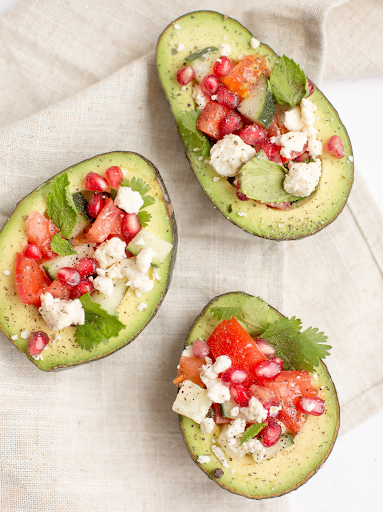
    • Fill an avocado with an egg and bake for 15-20 minutes at 425° F. Add crumbled bacon and season with fresh herbs. 

    • Here is another stuffed avocado recipe: Avocado Boats from Matthews Friends 

      • Note: This recipe calls for double cream which is ~48% fat content compared to ~36% in heavy cream. Double cream can be difficult to find in the US. You may need to use more heavy cream in this recipe to make up for the difference in fat content. 

  • As toppings

    • Use for toppings of keto sandwiches, tacos, or pizza. 

    • Try this Avocado Toast from Ketolicious Kid 

  • Grilled 

    • Cut the avocado in half and remove the seed. Drizzle with lemon juice and olive oil. Place cut side down on grill and cook for 2-3 minutes. Season. 

  • Pickled 

    • Place 1 cup of white vinegar, 1 cup of water, and 1 tablespoon of salt in a saucepan and bring the mixture to a boil. Pour the mix into a jar and add three diced, unripe avocados. Seal them with a lid and let them marinate for a few days before eating. 

Here are some great dessert-like avocado recipes: 

Charlie Foundation 

Matthews Friends 

In addition, check out our old blog post, Beat The Heat with Keto Popsicle Treats, where we list several popsicle recipes that incorporate avocado with formula but honestly, you can switch the formulas out for heavy cream and/or nut-based milk. 

Are you still struggling to get your little one excited about avocados?  Try rewarding him/her with these non-food-related items to get your kids on Team Avocado!  

This is only the tip of the iceberg for all the great ways you can incorporate avocados into your ketogenic diet journey. Leave us a comment with your favorite idea or avocado recipe!

Epilepsy-Related Reading List

By: Laura Dority MS, RD, LD & Daisy Argudin (parent advocate)

Epilepsy is hard… it’s hard for everyone… siblings, parents, grandparents, friends, and especially the kiddo with seizures. Epilepsy is complicated… there isn’t just one cure… one medication that works for one person doesn’t work for another…there are numerous different kinds of seizures and epilepsy syndromes. 

Epilepsy is not easy to explain… especially to younger children, so we compiled a list of books to help! 

Keto-Related

Krazy for Keto by Brandon Kopp (2023) 

The story of a young boy's successful journey on the medically prescribed Ketogenic Diet for Epilepsy. Based on the real-life experience of the author. 

After traditional medications failed to control his seizures, Brandon was admitted to the hospital where he initiated the Ketogenic Diet for Epilepsy in hopes of finding some seizure control. 

Brandon bravely learns how to acclimate to his new life on this restrictive diet while still attending school and socializing with other children. 

While not specific to keto, Gordy and the Magic Diet by Kim Diersen is a good option for children following any type of medically restricted diet. Unfortunately it is difficult to find but you may be able to find a copy at your local library or a used bookstore. Based on this list, it looks like the world could use more keto-specific books for children…..are you up for the challenge? 

For the next section of this blog, we have divided the list into a few subcategories:

  • Epilepsy-Related (for the patient) 

  • Epilepsy-Related (for friends and peers) 

  • Epilepsy-Related (for siblings) 

These books will help support your kiddo with epilepsy by giving them understanding and courage on their epilepsy journey. 

The Adventures of Buzz Bee by Jacqueline Ann Gibson (2015)

  • Buzz Bee has been feeling strange lately. He's been flying into flowers, falling over in the hive, and the worst thing of all: he has no idea why. After a visit to Dr. Glowden, Buzz Bee and his mommy finally find out what's going on - Buzz Bee has been having seizures. 

  • If your child is suffering from epilepsy, or has someone in their life with the condition, this book is a fantastic way to teach them about the disorder and how it's treated. 

  • It also reminds readers that those who suffer from epilepsy or any other disorder are just as normal as any other bee in the hive. 

The True Life Adventures of Spunky Monkey, The Magical Poodle by Lauren Michell Ruehring (2012)

  • Spunky Monkey The Magical Poodle is a dog with epilepsy who wanders off while at the park with his family and em"barks" on a day-long journey of self discovery. 

  • As he tries to find food, friends and medicine, he encounters a cast of funny, caring, helpful friends who give him hope, confidence and courage to find his way home. 

  • The True Life Adventures series uses real-life dogs to explore the issues of illness, disability and other life lessons from a gentle, entertaining and uplifting perspective that all children can relate to.

The Great Katie Kate Explains Epilepsy by M. Maitland DeLand (2014)

  • Jimmy and the other young patients in the neurologist's office get     a visit from the Great Katie Kate, a spunky redheaded superhero who appears when kids get worried. Katie Kate takes the children on a medical adventure to learn about the various forms of epileptic seizures and treatments.

  • This superhero saga provides an entertaining and indispensable tool for parents and medical professionals who are seeking a positive way to help young epilepsy patients understand their condition and deal with their fears. 

I Have Epilepsy. It Doesn’t Have Me by Jamie Bacigalupo and Judy Bacigalupo (2012)

  • Follow eight year old Jamie on her journey from being diagnosed with Benign Rolandic Epilepsy at age five. 

  • Jamie persevered and overcame her epilepsy and went on to help other children by starting her own non-profit that provides gifts to children in over five states.

Mommy, I Feel Funny! A Child’s Experience with Epilepsy by Danielle M. Rocheford (2009)

  • Based on a true story, Mommy, I Feel Funny! introduces the reader to Nel, a little girl who is diagnosed with epilepsy. 

  • The story takes you through the days following Nels first seizure. Suddenly, Nel and her family are faced with thoughts, fears and emotions that come with the discovery, understanding and acceptance of epilepsy.

Let’s Learn with Teddy about Epilepsy by Dr. Yvonne Zelenka (2008)

  • A book to help children and their families identify some of the symptoms of epilepsy and understand in an illustrative and enjoyable manner the doctor's visit. 

  • The book tells the story of a young boy first diagnosed with epilepsy, the doctor's visit, the different tests and possible treatment and his relationship with his parents and friends.

And Down Went Poss & Poss’s School Days Book by Anne Little

  • And Down Went Poss is a book that examines the feelings of a baby possum when he is first diagnosed with epilepsy. Little Poss feels sad and unhappy, but with help from a special friend, he comes to realise that we are all different and that life can still be full of fun. 

  • Poss’s School Days Book is the sequel to And Down Went Poss. It looks at what happens when Poss has a seizure one day at school. 

  • These books include ideas for activities which enhance the child’s understanding of the story.

Going to school and making new friends when you have epilepsy can be scary and intimidating.  Your kiddo might be concerned with fitting in. Other children’s exposure to epilepsy and therefore knowledge may be limited and incorrect. These books are great options for the classroom and friend groups to help support inclusivity and understanding. 

Did You Know That I Have Epilepsy? by Stacey Crouch (2020)

  • A true story of a boy named Cody, who has been diagnosed with epilepsy. 

  • It was written to help kids learn more about seizures and what could happen from a child’s perspective. 

  • It’s easy for children to understand and has colorful, engaging pictures.

Milo’s Day At School by Shawnee Walker (2020)

  • This book shares a heartwarming, informative story about a child who has a seizure at school.

  • The author informs young readers about epilepsy, and what to do if they see someone have a seizure in a kid-friendly language. 

Zeeba and the Seizure by Michaela Barnes (2020) 

  • A children's book that promotes seizure and epilepsy awareness. 

  • Zeeba Zebra planned to have a regular school day but began feeling unwell. Something unusual and scary happens that leads to an unexpected field trip to the hospital. 

  • A story that encourages children to embrace empathy, friendship, and courage.

Andie and the Storm by Lexie Griffiths (2021) 

  • Simplistic for young children to learn about seizures and how to help

  • Rhyming makes it fun to read aloud as a family, class, or as friends

  • Written and illustrated by a mom with first-hand experience and knows how difficult it can be to explain seizures to children

Taking Seizure Disorders to School: A Story About Epilepsy (Special Kids in School) by Kim Gosselin (2001)

  • This story dispels the myths and fears surrounding epilepsy in a positive, upbeat and entertaining style while explaining seizures in an understandable fashion.

Is Epilepsy Contagious? by Julie Devinsky (2011)

  • This book brings the story of epilepsy alive with easy-to-understand text and illustrations that are both informative and interesting for many questions kids ask about epilepsy. 

I Know Someone with Epilepsy (Understanding Health Issues) by Vic Parker (2011)

  • This book introduces readers to what epilepsy and other seizure disorders are, how they affect people, and what they can do to be a good friend to someone living with epilepsy.

Can I tell you about epilepsy? A guide for friends, family and professionals by Kate Lambert (2012)

  • Ellie, a young girl with epilepsy, invites readers to learn about epilepsy from her perspective. 

  • Ellie helps children to understand the obstacles that she faces by telling them what it feels like to have epilepsy, how it affects her physically and emotionally, how epilepsy can be treated and how the condition is often misunderstood. 

  • Ideal introduction for children, parents, friends, and professionals to make sense of the condition in its varying forms and will be an excellent starting point for family and classroom discussions.

We know it can be hard for siblings to have a brother or sister with epilepsy or any kind of special health care need. They may feel left out, scared, or even helpless to help their sister or brother. This list will help normalize their emotions and give ideas on how they can be brave and courageous for their sibling with epilepsy. 

Becky the Brave: A Story about Epilepsy by Laura Lears (2002) 

  • This story dispels the myths and fears surrounding epilepsy in a positive, upbeat and entertaining style while explaining seizures in an understandable fashion.

  • A story about a young girl's struggles with epilepsy. Becky is always helping her younger sister, Sarah. Sarah looks up to her brave older sister - until one afternoon when Becky suffers a serious seizure. When Becky recovers, she retreats into herself and refuses to return to school, anxious that her condition not be revealed to her new classmates. It is now Sarah's turn to be brave for her sister.

If you come across any other books that you think should be included, please leave us a comment and let us know!

Note: Only books that were available on Amazon as of 4/2023 were included on this list.

Quality Nutrition Sources - Why Quality Matters?

By: Kayla Hansmann, MS, RD, LD, CLC

When thinking about diet quality – across the spectrum of all diets, you’d be hard-pressed to find someone who would argue that the quality of what we’re eating isn’t important. While that might not be one of the first steps in implementing a medically prescribed ketogenic diet, it can certainly take precedence down the road once some of the other critical boxes are checked and everyone is feeling comfortable with how to navigate this new way of eating.

Dietary choices and lifestyle habits can be daunting to implement all at once so most dietitians will recommend some initial tweaks and changes to get you on your way to the desired diet endpoint. When doing so, most individuals and practitioners note that even these simple (yet consistent!) nutrition changes up front result in better control of seizures as well as improved behavior overall. The underlying theme in these changes includes reduced amounts of processed and packaged foods, no added sugar, and less concentrated sources of carbohydrates overall. 

Let’s dig into this a little further. Stripping away processed foods leaves us with whole, natural foods that provide higher satisfaction for both our palate and our body’s systems. Processed foods are more likely to include ingredients that are: 

  • harder for our bodies to digest

  • more likely to lead to abdominal distress (constipation or diarrhea)

  • prone to causing glucose spikes that lead to energy rollercoasters (often exhausting our body’s insulin)

  • more likely to lead to bloating and/or increased gas

  • providing an excess of calories and/or unhealthy fats without a ‘place to go’

…in other words: likely to increase inflammation which can increase our prevalence of acute or chronic illness and undesirable weight trends.

One easy way we can look at creating a plate or a day’s worth of meals that prioritize whole, natural foods is by following the “one ingredient rule”. Even if a food isn’t fresh or raw, you can flip over to the ingredient list to ensure each of the ingredients listed is just ONE ingredient, or itself, in whole-unadulterated form. Cut out the ingredients, cut out the processing! 

Once you’ve successfully gotten the majority of your meals and snack to encompass the one ingredient rule, you will notice your body starting to crave these foods more and a reduced desire to grab or reach for its other processed counterparts. Our bodies are smart and adapt—once you get to a certain point, your body CRAVES what it is actually eating!

Let’s recap, ways to add quality to our diet and why it matters, with an emphasis on keto-friendly sources:

Proteins

  • Aim for minimally processed proteins (i.e. whole chicken, eggs, ground turkey, various cuts of steak) – these foods are satiating and can keep us feeling full longer while also contributing important and highly available amino acids, B vitamins, iron, zinc, and choline. When possible, choose pasture-raised poultry for the higher amounts of omega 3’s found in the eggs and meat. 

  • Choose high-fat dairy which is also helpful in terms of satiety but also a good source of calcium, phosphorus, and vitamin D for strong bones, growth, and development.

  • Try and work in fresh fish a few times a week – omega 3 city! The EPA and DHA (omega-3 fatty acids) provide tremendous benefits for your heart, brain, lungs, and circulation.

Carbohydrates: 

  • Fruits & veggies – think: The higher the fiber, the lower the net carbohydrates. Fiber is not only FILLING but feeds the healthy bacteria in our gut (a happy gut = better absorption of important nutrients and increased bowel motility).

Fats: 

  • Nuts & seeds – great ways to add crunch with a fantastic mix of healthy fats, fiber, and often a better source of sodium to naturally “salt” our diet. A favorite keto staple is flaxseed and chia seeds which are loaded with alpha-linolenic (ALA) fatty acids – a commonly forgotten omega-3!

  • MOST IMPORTANTLY FATS – think half solid, half liquid. If we can make at least 50% of our fats unsaturated (usually liquid) and the other 50% or less saturated (usually solids: butter, coconut oil, fats from animals), we are on our way to improved fasting blood levels of triglycerides and cholesterol. Butter/ghee is a great way to pack a punch, but we want to ensure that we’re incorporating mono- and omega-3 poly-unsaturated fats to boost our HDL cholesterol and provide protection against heart disease as well as packing a dose of potent antioxidants. Amazing monounsaturated fat sources are extra virgin olive oil and avocados. 

The final trick to adding quality? Self-love and self-regulation! Without these two essential ingredients, we’ll be cycling through the roundabout of shame and guilt that will make it very difficult to lead to healthy habits long-term. A calm and stress-free environment helps us digest food better, enjoy food more, and be more likely to grab the more nutritious choice time after time.

Hippity-Hoppity Keto-Friendly Easter Recipes & Activities

Recipe and Content Contributor: Taylor Parrish, RDN, CLC, LD

Wow, I can’t believe it’s already springtime and a furry bunny has been spotted hopping around your neighborhood! Whether you celebrate Easter for its biblical significance or not, most families take part in the Easter festivities – egg hunts, baskets, brunch/dinner, etc. 

Most holiday festivities include food and being on keto and not eating what other kids are eating can be very difficult. However, as a parent, we can refocus on what’s important and how we celebrate different holidays. Being on keto is a great way to start new traditions or refresh old traditions where holidays aren’t just about the treats involved. Don’t get me wrong – treats are yummy and there’s a place for them, but if you find yourself struggling with holidays because of the treats, now is a great time to find a new way to celebrate. 

Check out this article from Country Living that may help you celebrate Easter a little differently this year. Although not all these ideas are appropriate for keto, there are some cute ideas to consider that don’t involve food.  And I don’t know about you, but my kiddos just love the hunt for the Easter eggs…not necessarily what is inside of them!

Also, check out our family’s toilet paper bunnies from Easter in 2020 – when TP was a hot commodity.

Here are some more non-food ideas to help you celebrate Easter: 

Check out these store-bought Easter candies and kitchen gadgets: 

Favorite Easter Recipes 

We hope these activities, ideas, and recipes make your keto Easter and springtime a little bit tastier! Please share your tips and tricks on how you and your keto hero celebrate the Easter season when navigating a ketogenic diet.

Managing Ketosis: The Ins and Outs of Keeping Ketosis Safe

Content Contributor: Taylor Parrish, RDN, CLC, LD

Ketones, ketones, ketones…..when you or your child are on a ketogenic diet it may feel like ketones are running your life! Your doctor asks your ketone level, your dietitian asks your ketone level, and you are likely tracking your ketone levels at home but what is all this business about ketones really about? Let’s take a deep dive into what factors impact ketones and why you may notice your ketone levels vary! 

What factors can lower your ketone level?  

  • Illness & Stress: Sickness (without vomiting and diarrhea) may lead to a decrease in ketone levels. Additionally, stress hormones (often a factor with illness) can lead to an increase in glucose levels which then can lower your ketones.  

  • Weight Gain: While normal weight gain is appropriate and necessary for children, excessive weight gain can lead to lower ketone levels. Your dietitian will keep a close eye on your child’s weight gain to make sure it’s appropriate for her/his individualized plan. 

  • Hidden Carbohydrates: Have you stopped measuring? Have you started eyeballing portions? If so, has your “eyeballing” portions gotten a bit incorrect?  Double check your portion sizes and make sure they are accurate. In addition, remember carbs can be hiding in many medications, sweeteners and herb/spice blends. 

  • New Foods: If you have added a new food into your keto plan (especially a “keto” marketed food), double check the amount of sweetener and fiber in the product. Even if it’s a keto approved sweetener or sugar alcohol, some people respond differently to these ingredients – this is why it’s important to track, especially when trying new foods, to see a response.  It is important to also note that some sweeteners can take up to 24 hours to take effect. 

  • Inadequate Carnitine: Carnitine is an important factor in fat metabolism because it helps fat get used for energy.  Ketogenic diet therapy utilizes more fat than those not on keto so the need for carnitine increases. It is common to have insufficient carnitine when on ketogenic diet therapy so be sure to keep up with your regularly scheduled lab work to get an accurate measure of your carnitine levels.   

  • Time of Day: Ketones are generally lower in the morning due to the dawn phenomenon which is when cortisol (a hormone) is released in the morning. Cortisol tells your liver to use up stored glucose (glycogen) because your body has gone more than 4-5 hours without energy (food). The pancreas then secretes insulin. Insulin can decrease ketones. In addition, as you eat fat throughout the day your ketone level generally increases.  

  • Inadequate Fat Intake: Be sure you are eating your recommended amount of fat daily. If you aren’t eating enough fat as prescribed by your keto team, you likely will have lower ketone levels. 

  • Hydration: Remember that urine ketones are hydration dependent. If you drank a much larger amount of fluids than normal, it may decrease the reading on your urine ketone strips due to your urine being more diluted.  

  • Body Care Products: Some individuals may be sensitive to carbohydrates in body care products such as lotions and shampoos.  While this may not apply to all individuals, if you are really struggling with ketosis and you’ve exhausted all other avenues, take a deep look into your body care products. The Charlie Foundation and the Keto Hope Foundation collaborate each year on the resource, “No and Low Carb Personal Care Products Guide,” which is available for download from the Charlie Foundation store for $8.99.  It can be very helpful to find products such as sunscreen, toothpaste, shampoo and lotion (to name a few) that are keto friendly.

What factors can increase your ketone level?  

  • Dehydration: Ketogenic diet therapy has a diuretic effect, so getting enough hydration is essential in maintaining a safe level of ketosis. Being in ketosis puts your body into more of an acidic state, which is why your keto team looks at your CO2 (bicarbonate) levels– a measure of acidosis. The goal is to induce ketosis but prevent excessive acidosis which can be exacerbated when we are dehydrated. 

  • Weight Loss: If you are losing weight due to inadequate calorie intake, you will start to burn your own fat stores which means higher ketones. 

  • Medium Chain Triglycerides (MCT) Oil: MCTs are easily absorbed and bypass much of the digestion process. Because of this easier digestion, MCTs provide a quick energy source for ketone production. If you want to learn more about MCT oil, check out our blog, The Adventures of MCT Oil

How Do I Best Manage Ketosis? 

  • Eat meals and snacks at the same time each day as prescribed by your keto team. Avoid skipping any meals/snacks. 

  • Monitor weight closely. 

  • Communicate with your keto team frequently. Keep them informed of ketone levels, glucose levels (if applicable), seizure control and your child’s behavior. 

  • Track your ketones as recommended by your keto team. Whether you are using urine or blood ketone measurements on your ketogenic journey, it’s important to track and report your levels to your keto team. They may ask you to check once a day or several times a day – everyone’s plan is different, but your keto team can use this information to tweak your ketogenic diet to obtain the best seizure control possible. 

  • Track your meals in a food tracking application such as MyFitness Pal (Note: This applies to those on a Modified Atkins Diet or Low Glycemic Index Treatment.) 

  • Stay hydrated. If you do not know your fluid goal, ask your keto team! 

  • Be aware of signs/symptoms of excessive ketosis including nausea, vomiting, rapid or shallow breathing, extreme sleepiness, and/or facial flushing in combination with high ketones. Typically, excessive ketosis cannot be identified by just ketone levels alone – it’s best to look at the big picture of symptoms alongside high ketone levels. If your child has any signs/symptoms of excessive ketosis, notify your keto team. 

Disclaimer: The advice mentioned in this article is not medical advice and should not be taken as medical advice. You should always check with your medical provider if you have any questions about your ketone level. 


Constipation and Keto for Epilepsy

By: Sarah Metzger, MS, RD, LD, CDCES 

Never underestimate the power of a good bowel regimen. Constipation can wreak havoc in anyone’s life, and for those with epilepsy on the ketogenic diet, constipation can become the down-right enemy! For people who have neurological diseases, such as epilepsy, the connection between the brain and the gut can get disrupted. Because the brain coordinates the nerves and muscles needed to perform bowel movements, any neurological diseases or injuries can impact the signaling as well as the contraction of muscles in the colon. Constipation is a common side effect of multiple other diseases that affect the brain, such as stroke, Parkinson’s disease, spinal cord injury, and multiple sclerosis. Although there is little available data, epilepsy also correlates with higher levels of constipation (1). Some anti-seizure medications may also cause constipation, as 27% of patients from a 2021 study who were taking one or more anti-seizure medications experienced constipation. Among patients taking multiple anti-seizure medications, constipation was experienced most frequently among those taking carbamazepine, phenobarbital, and Dilantin (1).

When we add in the ketogenic diet, things start to slow down even more. Constipation is a well-known side effect of the ketogenic diet. The classic ketogenic diet has approximately 90% of its calories coming from fat. Fat moves through the body at a slower rate than other nutrients. This can be advantageous because it can keep one fuller for longer, but it also slows down digestion leading to constipation. Even the Modified Atkins ketogenic diet, which has around 60-70% of calories from fat, can cause the body’s digestion to slow down significantly too. Additionally, the ketogenic diet may be lacking in fiber due to low carbohydrates and low fruit/vegetables in the diet. However, there are some keto-friendly fiber foods, which will be discussed later in this article. 

One of the best ways to help prevent constipation is hydration, hydration, hydration - meeting or exceeding one’s fluid needs is an absolute must! Talk to your dietitian for your child’s specific fluid goals. Another way is with movement! Talk to your physical therapist for specialized movements for constipation specific to your child. Because of the addition of the ketogenic diet, medication may also be necessary to help with gut regularity especially for tube-fed patients. 

There are two main categories of medications that help constipation: the ‘Mushers’ and the ‘Pushers’. The ‘Mushers’ are a group of medications that helps draw water into the stool making it easier for stool to pass through the colon (also known as osmotic laxatives).  The most common keto-friendly "musher" is MiraLAX® (polyethylene glycol 3350) and is typically the first line of treatment.  Some side effects may include looser and/or more frequent stools. It’s a flavorless powder that can be easily added to water flushes/drinks throughout the day (2). Another ‘musher’ is Milk of Magnesia (also known as magnesium hydroxide or citrate). It also works by helping draw water into the stool. Like MiraLAX®, common side effects include looser and/or increased frequency of stools.  Lactulose is another ‘musher’ but not typically used on the ketogenic diet due to possible carbohydrate content. 

Insoluble fiber is an honorary musher as well. It acts in the digestive system by bulking and softening the stool because it is not dissolvable in fluids. Instead, insoluble fiber absorbs fluids in the gut and sticks to other waste materials to make softer stool. Fiber can be harder to consume on the ketogenic diet because most sources are high in carbohydrates. However, nuts, cauliflower, green beans, carrots, and berries can fit into the ketogenic diet. Another interesting food that contains 85-93 % insoluble fiber is chia seeds. Chia seeds also have an impressive lipid content, therefore, depending on the brand, chia seeds are ~1:1 ketogenic ratio and may fit into your child’s ketogenic diet (3). 

A subcategory of mushers could be called ‘gliders’. Gliders also help stool move through the colon by using lubrication. One commonly used ‘glider’ is mineral oil. Mineral oil helps to lubricate the stool and helps the stool retain its water content for a similar effect of making it easier to pass. Though some oil may leak out with the stools, there are not many significant side effects of mineral oil.

And now for the ‘Pushers’. This category of medications works differently and can oftentimes be the winning ticket for people who live with neurological dysfunction. Senna (Senokot®) is made from the leaf of pod of the Senna alexandrina plant. It comes in an over-the-counter medication and in some teas, such as Smooth Move® tea. It works to irritate the colon to help it contract and expel stool. Some typical side effects can be bloating, cramping or a general upset stomach (4). Glycerin and Dulcolax® (bisacodyl) suppositories are other colon stimulant options. They are both inserted into the bum to help lubricate and stimulate the colon to move. Glycerin suppositories contain purified water, sodium hydroxide, stearic acid and 90% glycerin (5). Dulcolax® has the active ingredient of bisacodyl that helps stimulate and hydrate the colon. Suppositories tend to work more quickly and are used on a shorter term vs. Miralax® or senna. Suppositories may leak out and/or may cause irritation, cramping, and bloating (6).

Always remember that adequate water intake is necessary for these medications or remedies to work properly. Talk with your doctor/dietitian about your child’s ideal fluid needs. If you are wondering about long-term side effects of these medications, please talk to your doctor as that is out of the scope of this post.  What products, supplements or nutrition changes have made a positive difference in your keto journey world?  Share here as a comment!

Reindeer-Inspired Keto Friendly Holiday Recipes & Activities

Recipe and Content Contributor: Taylor Parrish, RDN, CLC, LD

Like Halloween and Thanksgiving, food is often one of the main spotlights of the Christmas season. Check out these keto friendly Christmas activities and recipes. Your keto kiddo doesn’t have to miss out on this magical time! From the whole team at the Keto Hope Foundation, we hope you find joy in this season and have a very Merry Christmas, Happy Hanukkah, and a Happy New Year! 

First, check out these fun holiday ideas where food is not the focus!  

Now, let’s look at some easy and convenient store-bought items that can brighten your holiday.* 

*Always check with your keto medical team if the above-mentioned products are appropriate for your specific ketogenic diet. Some of these products do contain artificial sweeteners and sugar alcohols that may not be appropriate for everyone. 

Recipe 1: Keto Cinnamon Rolls (makes ~9 cinnamon rolls)

Dough Ingredients: 

  • 112 g (1 cup) almond flour 

  • 26 g (1/4 cup) ground flax 

  • 7 g (1 Tbsp) coconut flour 

  • 48 g (1/4 cup) erythritol 

  • 8 g (2 tsp) baking powder 

  • 1.5 g (1/4 tsp) salt 

  • 56 g (1/4 cup) butter, softened 

  • 50 g (1 large) raw egg 

  • 3 g (1/2 tsp) vanilla extract 

Cinnamon Streusel Filling Ingredients: 

  • 56 g (1/4 cup) melted butter 

  • 36 g (3 T) erythritol 

  • 7 g (1 T) cinnamon 

Directions: 

Preheat oven to 325°F. Line pan with parchment paper on a flat sheet or 8x8 square pan. Combine dry ingredients in large bowl and add softened butter and distribute through dry ingredients. Combine egg and vanilla, stir. Add to dry mixture. Place dough on large sheet of parchment paper then fold paper in half so that the paper is sandwiching the dough. Start to work the dough into a flat rectangle between the parchment paper, using a rolling pin if needed. Once flattened, the rectangle should measure 9 x 12 inches. 

Next make cinnamon streusel filling by combining melted butter, erythritol, and cinnamon in a small bowl. Spoon filling over rolled out dough and spread to cover. Using parchment paper as a guide, start from one of the shorter ends and begin rolling slowly. Once you have completed rolling, use a knife to cut the roll into 9 slices, and place each slice cut side down in the pan. Bake for 15-20 minutes and allow to cool. 

Nutrition Information (1 cinnamon roll): 190 calories, 18.1 g fat, 4.2 g protein, 2.55 g net CHO at a 2.65:1 keto ratio

Recipe 2: Snowflake Toast

Ingredients: 

  • 35 g fresh strawberries 

  • 2 slices (56 g) L'Oven fresh bread 

  • 2 Tbsp (28 g) butter 

  • 2 Tbsp (10 g) unsweetened shredded coconut 

  • 2.5 oz (70 g) cream cheese (block) 

Directions:

"Toast" bread with butter. Spread cream cheese on bread and sprinkle with unsweetened shredded coconut. Serve with 35 grams strawberries.

Nutrition Information (entire recipe): 586 calories, 55.4 g fat, 16.1 g protein, 5.8 g net CHO at a 2.5:1 keto ratio 

Recipe 3: Cheeseball 

Ingredients: 

  • 8 oz (224 g) cream cheese, softened 

  • 1/2 cup (52 g) shredded cheddar cheese 

  • 1/2 cup (50 g) chopped green olives 

  • 1/4 cup (16 g) chopped green onions 

  • 1/2 cup (50 g) chopped pecans - for outside 

  • 2 Tbsp (8 g) raw parsley - for outside 

Directions: 

Combine all ingredients (except pecans and parsley) and shape into a ball. Lay out plastic wrap (enough to cover cheeseball) and put pecans and parsley on top of it (centered). Place cheeseball on top of pecans and parsley and roll to cover the outside (it's OK if it doesn't cover the entire cheeseball). Wrap up with the plastic wrap. Place in fridge until ready to eat! Serve with raw vegetables (carrots, cucumbers, etc.) or try these keto friendly almond crackers from the Charlie Foundation. 

Nutrition information (entire recipe): 1430 calories, 138.8 g fat, 32.6 g protein, 13.1 g net CHO at a 3:1 keto ratio

Recipe 4: Ham & Au Gratin Cauliflower (makes 2 servings) 

Ingredients: 

  • 1 small head (265 g) of cauliflower, chopped (weigh this then steam) 

  • ½ cup (120 g) cream

  • ¼ cup (28 g) cheddar cheese, grated

  • ¼ cup (56 g) butter 

  • 2 oz (56 g) Ham (Off the Bone Black Forest ham) 

  • Salt and pepper, to taste 

Directions: 

Steam the cauliflower and place in a dish. Melt the cheese and butter and mix well, then add the cream and combine. Pour sauce over the steamed cauliflower and mash to desired consistency. Divide into two servings then top each serving with 1 oz (28 g) ham. 

**Could consider baking this in the oven for a crunchier & well-done texture.

Nutrition information (entire recipe): 1060 calories, 101 g fat, 24.4 g protein, 12.8 g net CHO at a 2.7:1 keto ratio

Recipe 5: Chicken and Cabbage Soup (a great option for New Year’s Day) 

Ingredients: 

  • ½ cup (120 g) chicken broth, Imagine Organic 

  • 1/4 cup (40 g) raw green cabbage, shredded 

  • 1 Tbsp (10 g) raw onion, diced small 

  • 1 clove (4g) raw garlic, diced fine 

  • 1 oz (28 g) cooked chicken breast, diced - for higher ratio, can use dark meat chicken 

  • 1 Tbsp (15 g) butter 

  • 1 Tbsp (15 g) olive oil 

  • 1 Tbsp (15 g) Hellman's mayonnaise 

  • Salt & pepper, to taste 

Directions: 

Add the butter and olive oil to a small pot. Over medium low heat, melt the butter. Add the cabbage, onions and garlic to the butter and oil. Sautee until the vegetables begin to soften. Add the broth and chicken to the vegetables. Cover and let the soup simmer over low heat until the vegetables are very soft. Remove the pot from the heat and add the mayonnaise. Use an immersion blender to puree the soup. 

Note: If the soup reduces too much, you may add a little water. The mayonnaise is used to help keep the ingredients emulsified once it has been pureed. If you prefer not use mayonnaise, heavy cream or additional butter and oil may be used in its place. Pureeing the soup is optional. 

Nutrition information (entire recipe): 420 calories, 40.4 g fat, 10.2 g protein, 3.9 g net CHO at a 2.85:1 keto ratio. 

Recipe 6: Hot Chocolate

Ingredients: 

  • 2 Tbsp (30 g) cream 

  • 1 tsp (2 g) unsweetened cocoa powder (Hershey’s) 

  • 1 cup (240 g) unsweetened almond milk 

  • Sweetener, to taste

  • 5 total (~8 g) Max Mallows 

Directions: 

Combine all ingredients (except Max Mallows) in a microwave safe container and microwave until desired temperature. You can also use the stove top to warm ingredients as well. Top with 5 Max Mallows

Nutrition information (entire recipe): 250 calories, 24.3 g fat, 3.1 g protein, 4.6 g net CHO at a 3.1:1 keto ratio 

*To increase the ratio, increase the amount of cream inside the recipe or added on top as a “whipped” cream. To decrease ratio, increase Max Mallows or decrease amount of cream.

Looking for more amazing keto friendly recipes? Check out these from some of our keto friends! 

We would love to hear about the things you’ve come up with for the holiday season and any keto friendly recipes you’ve tried, so please leave your best holiday tips as a comment!

Gobble, Gobble, Gobble: Thanksgiving Keto Cooking

Recipe and Content Contributor: Taylor Parrish, RDN, CLC, LD

November is here, y’all! The weather has already let us know that summer is a thing of the past, but the beautiful changing leaves make it all worth it! Now that Halloween is over, the next holiday is Thanksgiving. With Halloween, your biggest keto “stressor” may have been the treats and candy. With Thanksgiving, it might be the abundance of carb heavy foods and more time surrounding the dinner table with extended family. When I think of Thanksgiving, I think of turkey or ham covered in some sort of sauce or gravy, mac and cheese, rolls, pumpkin pie, and all the fixings! Guess what?! You can have all these things! 


Check out these resources and recipes using your favorite Thanksgiving and fall foods that are still in line with your child’s appropriate macronutrient ratio.


Recipe 1: White Chicken Chili 

Note: This recipe was adapted from The Keto Cookbook

Ingredients

  • 2 T +1 tsp (35 g) cream 

  • 1/4 cup (60 mL) chicken broth - OK to add a little more 

  • 2 T (22 g) Great Northern beans, canned and drained 

  • 1.5 T chopped bell pepper 

  • 15 g cooked chicken breast 

  • 1 T (16 g) olive oil 

  • About 3 (9 g) macadamia nuts, chopped 


Toppings: 

  • 1 T grated cheddar cheese 

  • 1 T (14 g) avocado OR 1 T (14 g) sour cream 

  • 2 g scallions (optional)


Directions

Combine the broth, cream, cooked chicken, olive oil, macadamia nuts, peppers, xanthan gum, salt and pepper, and a dash of cumin (really helps boost flavor) in a microwavable bowl. Stir very well to combine. Make sure that the xanthan gum is fully incorporated and not lumpy. Microwave for about 1 minute until warmed through. Top the soup with shredded cheese, avocado (or sour cream), and scallions.

Nutrition Information (per serving): 430 calories, 5.9 grams net carbs, 40.5 grams fat, 10.2 grams protein (2.5:1 ketogenic ratio) 


Recipe 2: Cheesy Biscuits 

Ingredients: 

  • 1 1/2 cup (168 g) almond flour, blanched, finely ground 

  • 2 T (30 g) cream 

  • 1/4 tsp baking soda 

  • 1 tsp baking powder 

  • 1/4 c (28 g) cheddar cheese, grated 

  • 1.5 T (21 g) butter, chopped

  • 1 large (50 g) egg, room temp 

  • 1/8 tsp garlic salt (can use normal salt) 


Directions: 

Preheat oven to 350°F. Line a baking sheet with parchment paper. Mix almond flour, baking soda, baking powder, and garlic salt (or just salt) together in a bowl. Then, use a fork to cut in the chopped butter until crumbly. Add egg, cream, and cheese and mix until well combined - can use the fork to do this. Use a small ice cream scoop to scoop out biscuit dough on baking sheet lined with parchment paper to make 15 small biscuits. Bake at 350°F for 10 minutes or until slightly golden on top. 

Serve with 1/2 tsp (3 g) tsp butter on top of each biscuit. If you have a higher ratio, simply add more butter on top. Can be frozen, as well.


Nutrition Information (per biscuit): 114 calories, 0.9 grams net carbs, 10.8 grams fat, 3.3 grams protein (2.5:1 ketogenic ratio) 


Recipe 3: Squash Casserole

Note: This recipe is from the Fit Mom Journey Ketogenic Living Blog 

Ingredients: 

  • 1 cup (238 g) cream 

  • 2 medium (350 g) zucchini 

  • 2 medium (350 g) yellow squash 

  • 1 -2 T (15 g) shallots, chopped 

  • 2 tsp (6 g) minced garlic 

  • 1/3 cup (38 g) shredded Cheddar cheese 

  • 1/2 cup (50 g) grated Parmesan cheese 

  • About 1/4 cup (60 g) butter 

Directions:

Preheat oven to 450°F. Heat a large skillet over medium/high heat. Add the shallots, garlic and butter. Sauté until the shallots are translucent. Slice the zucchini and squash, then add to the skillet along with the heavy cream. Add salt, pepper, and parmesan cheese. Cook for 8-10 minutes, or until bubbly. Coat an oven-safe baking dish with olive oil or coconut oil cooking spray. Transfer the contents of the skillet to the baking dish. Sprinkle with a little more Parmesan cheese and shredded cheddar. Bake for 10-15 minutes until it is bubbling and just starting to brown on top. Makes 8 servings. 


Nutrition Information (per serving): 201 calories, 5 grams net carbs, 18  grams fat, 4 grams protein (2:1 ketogenic ratio) 


Recipe 4: Pumpkin Microwave Pudding 

Ingredients:

  • 2 T (30 g) canned pumpkin, unsweetened 

  • 2 T (30 g) cream 

  • 25 g Ricotta cheese (whole milk) 

  • 36 g raw egg 

  • 1.5 T (22 g) T butter 

  • 1/4 tsp pumpkin pie spice or cinnamon 

Directions: 

After measuring all ingredients on a gram scale, combine in a microwaveable bowl. Heat in 30-sec increments, stirring very well after each cycle (~ 4 cycles). Heat the pudding until the temperature reaches 160° F. The eggs will begin to cook around the edges. Stir very well again and serve.

Nutrition Information (per serving): 370 calories, 3.6 grams net carbs, 35.4 grams fat, 8.5 grams protein (2.9:1 ketogenic ratio) 

Recipe 5: Cinnamon Sugar Pecans  

Ingredients:

  • 216 g pecans 

  • 10 g sugar 

  • 5 g cinnamon 

  • 1 large egg white (about 33 g) 

Directions:

Preheat oven to 325° degrees F. After measuring all ingredients, combine them in a small mixing bowl and stir to evenly coat pecans. Using a spatula, place the pecans on a baking sheet lined with a silicone mat or parchment paper. Scrape all the remaining egg whites out of the bowl and onto the pecans. Try not to let the pecans touch each other. Bake in oven for about 15 minutes. Allow to cool and then divide evenly into 6 servings. Store in a small air-tight container. 


Nutrition information (per serving): 260 calories, 3.5 grams net carbs, 3.9 grams protein, 25.9 grams fat (3.5:1 ketogenic ratio) 

**To make a 2.5:1 ratio, pair with 1 (28 g) mozzarella cheese stick per serving.


Recipe 6: Turkey “Lunchable” Idea 

Ingredients: 

  • 1-piece (28 g) L’Oven Keto Friendly bread 

  • 1 T (16 g) butter (spread on bread or use it to “toast” bread) 

  • 1 oz (28 g) (1-1.5 slices) Oven Roasted Deli Turkey 

  • 1 T (15 g) Hellman’s mayonnaise (spread on bread or turkey meat) 

  • 2 T + 1 tsp (35 g) Ranch (or can use 1 Hidden Valley Ranch cup) 

  • 3 baby (18 g) carrots 

  • 1 medium (12 g) strawberry 

  • 5 g Lily’s Chocolate Chips


Nutrition information: 465 calories, 5 grams net carbs, 12.5 grams protein, 43.8 grams fat (2.5:1 ketogenic ratio) 


Looking for more recipes? 

Check out these other amazing Thanksgiving recipe resources from a few of our friends in the Keto Community. 


We hope these recipes make your keto kiddos Thanksgiving and fall season a little bit tastier! Please share your tips and tricks for thriving during the holiday season when navigating a ketogenic diet.